Exercise: Production Precepts
The workshop is intended to model a Just-In-Time economy of print production, running counter to the contemporary assembly-line realities of large-scale publishing. This involves avoiding waste by working on-demand, utilizing local cheap machinery, considering alternate distribution strategies, and collapsing distinctions of editing, design, production and distribution into one efficient activity.
The Year According to David Reinfurt, Walker Art Center
Similar to how a flowchart can help determine a function within your product, a diagram can embody a set of principles for the manufacturer/company behind your product (you).
Taking inspiration from Ford's referencing the meat packing plant in order to make the assembly line, or how Toyota found inspiration in the supermarket to create their TPS (Toyota Production System) house, what inspirations and models are relevant to your company and product?
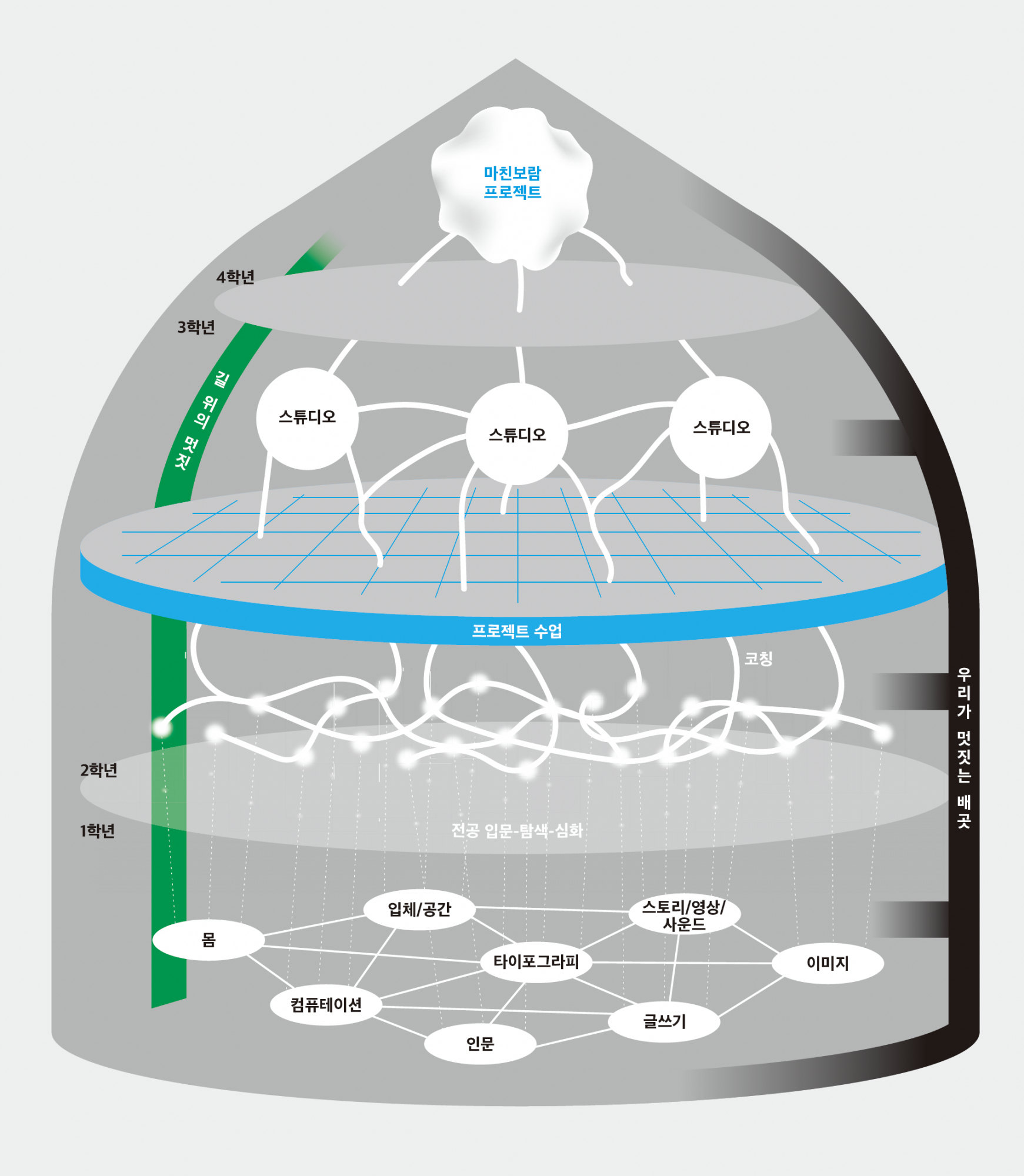
PaTI Curriculum Structure
In this exercise, you will consider the outlook of your product, and its manufacturer (you) and embody these in a set of precepts you arrange in a diagram. These ideas should both be practical (they will inform and be inspired by the production of your product) and aspirational (they will embody the ideals of your "company"). To kick off the project, get in pairs to begin the exercise:
- Discussing with your partner, each choose an existing model of production or site of exchange (a meat packing plant, grocery store, etc.) and extract principles from this site. If the grocery store represents a “just in time” model of production, what principles does the train station represent? If a meat packing plant shows the power of linear movement and rote and standardized (dis)assembly what ideals/methods/outlooks does the sports stadium embody?
- Next each select a built or natural structure (a production line, house, pond, etc.) to map your principles onto. Consider how the attributes of the structure infers a relationship with your principles. For instance, a house has a foundation, walls and a roof that all have a utilitarian function. What are the functions of the structures in a beehive, or a bridge?
- Discuss and refine your diagram based on the product you are manufacturing, and how you intend to produce it. Based on your principles and diagram consider how they informs the format of your product (is it digital, or physical? a poster, book, puzzle, deck of cards? etc.), its materials, and the steps involved for creation. Take into account how the principles of mass production – standardization, atomization, and reproducibility can play into your design. It’s a bit counterintuitive, but at this point you are being asked to look to the future after your yet-to-be determined design phase to the production phase. Thinking through how you may go about producing your product, should also inform the design of your product.
- Format your final diagram as 1080 by 1080px vector illustration.
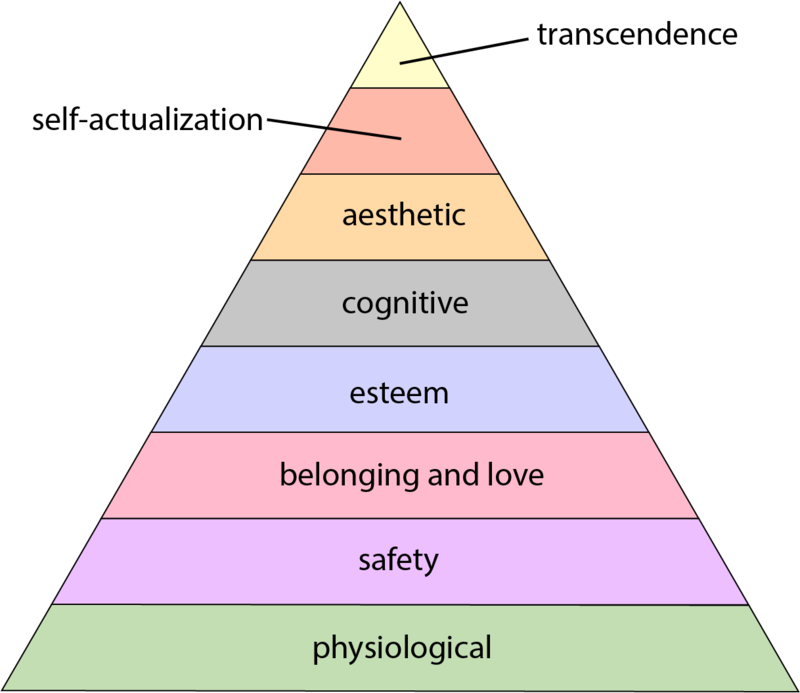
Maslow's Hierarchy of Needs
When selecting your sites and structures, consider what your goals are for your company and product and how they relate to your decisions. For instance if you make a product that encourages self-reflection is the site you extract values from a library, and the structure you map them onto a burrow? How does your product and "company" influence your choices?
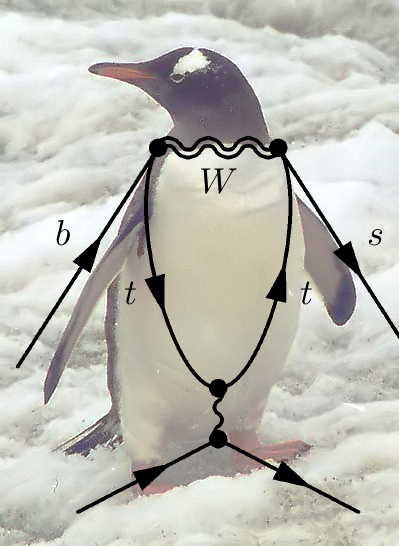
Penguin Diagram
Ultimately, consider how far the design process extends into the mechanisms of a company. production is part of rather than separate from the design process.
Begin the exercise in class today in pairs, and finish it over the next week independently.
Deliverables
- A digitally rendered 1080 by 1080px diagram
Schedule
- 9/29: Kick-off exercise
- 10/6: Share diagrams
References
- Amazon Drivers Placed Under Robot Surveillance Microscope by Jay Stanley
- Anatomy of an AI System by Kate Crawford and Vladan Joler
- CoRaL Web Browser by Choong-geun Yoon
- The Ford Assembly Line, American Experience
- Frank and Lillian Gilbreth original films uploaded by Axbom Innovation AB
- How Toyota Changed The Way We Make Things, Bloomberg
- Inside Amazon: Wrestling Big Ideas in a Bruising Workplace by Jodi Kantor and David Streitfeld
- Keeping you on Track: Remote Work Surveillance Software, Productivity Metrics, and Platform Managerialism by Ali S. Qadeer and Edward Millar
- Time and Motion Studies, American Photography
- 2014: The Year According to David Reinfurt
by David Reinfurt
Diagram References
- Adult | Child Diagram
- Ball of Grief Diagram
- Information Fusion Diagram
- Diagrams by agustine zegers
- Factorization Diagrams
- Generative Somatics Diagram
- Penguin Diagram
- Phenomenal View of Reality Diagram
- Printing Diagram
- Remote Login is a Lot Like Astral Projection Diagram
- Schematic presentation in a single picture of all muscle effects by Carl-Herman Hjortsjö
- Understanding Computer Technology Toilet Diagram
- You are Here Diagram


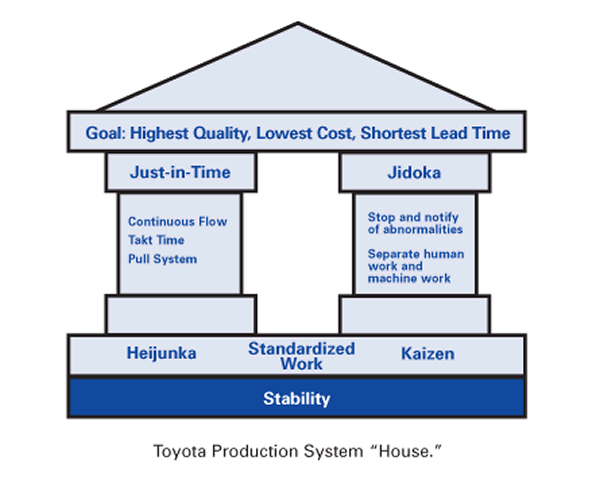
The Toyota Production System House
Due Oct 22 (1 week)
Topics: Diagram, Best Practices, Metaphor